

Five years of contract data. One pattern.
Ask any small business owner why they've never bid on a government contract, and you'll hear the same line: "That's for the big guys." It's often said with a shrug — like it's a fact, not an opinion.
We went looking for proof. We tracked every company that won a public tender in Portugal over five years, to see how often they won. What we found isn't the scenario everyone assumes, where a handful of big corporations dominate the market. It's something more complex — and if you sell to the Portuguese government, a lot more useful to know.
One thing this is not: a name-and-shame list. Nobody below did anything wrong. This is simply a map of how the game actually works.
Open on Paper. Closed in Practice.
Here's the twist: the biggest companies don't actually hold that much of the money.
Between 2021 and 2025, Portugal awarded €84.69B across 1,048,133 contracts to 194,706 distinct companies. The five biggest winners took just 5.44% of that total — nowhere near "monopoly" territory.
But look at who those winners are, and the story flips.
Most of them aren't new faces. Over the last five years, 87.2% of all contracts (914,315 of 1,048,133) went to companies that had already won tenders in Portugal.
So which is it: an open market or a closed club? Both. That's the part everyone gets wrong.
Nobody owns this market. But almost everyone standing in the winner's circle has already been let in before. It's not a monopoly; it's a guest list. And once you're on it, you keep getting invited back.
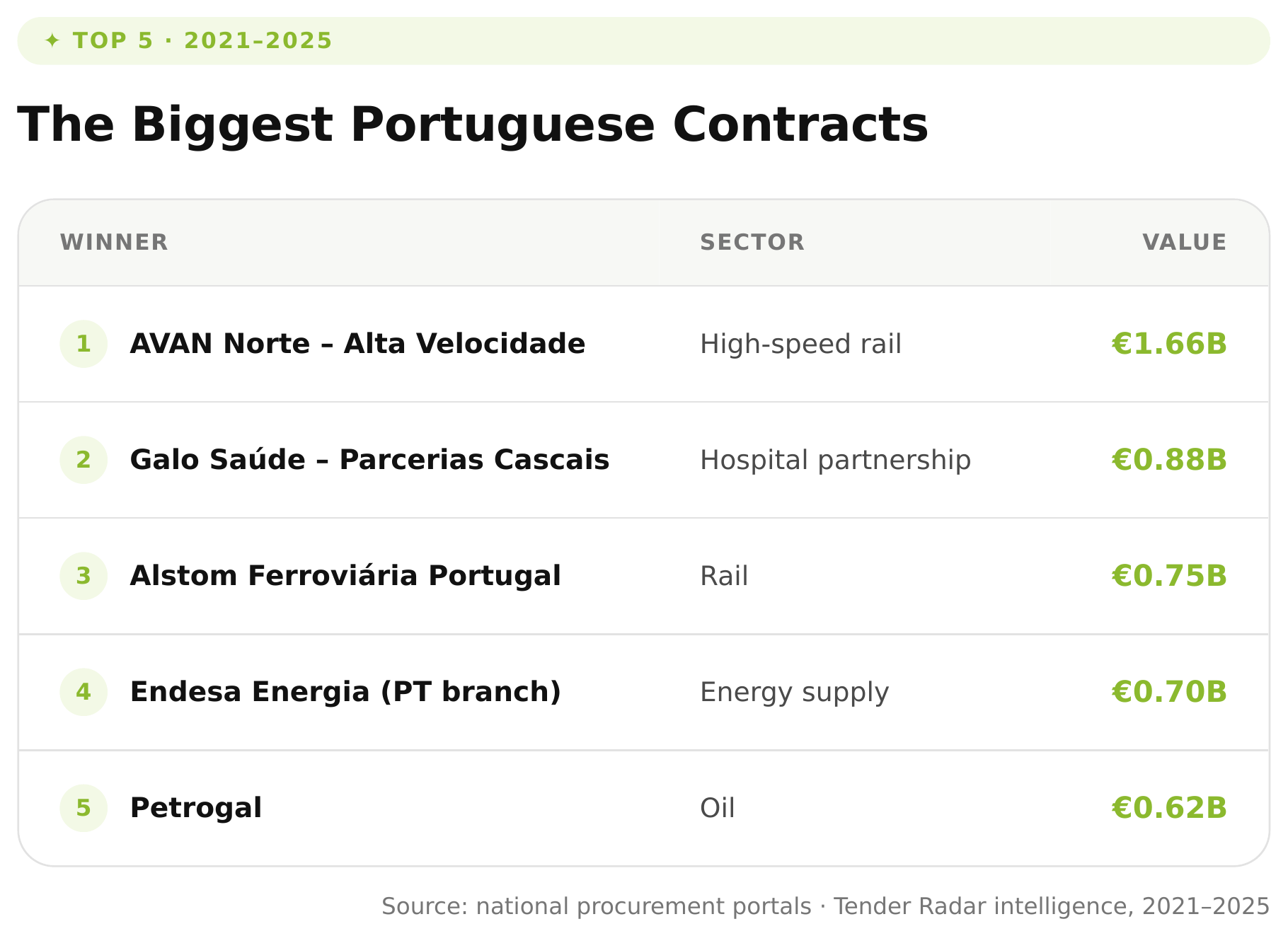
Nobody hands billion-euro contracts in energy, oil and rail to a stranger. But once you're in, you're trusted.
Look at the Sectors Where the Money Doesn't Go
Construction dominates the budget, accounting for 30.6% of all value awarded. Add Medical/Pharma (18.0%) and Fuel/Petroleum (5.2%), and these three sectors make up 53.8% of everything spent.
But opportunity lies in a handful of sectors that barely register at all: real estate and oil & gas services each account for just 0.02% of total value.
These niches are too marginal for the giants to bother chasing, which is exactly why they're worth your attention if you're a smaller player.
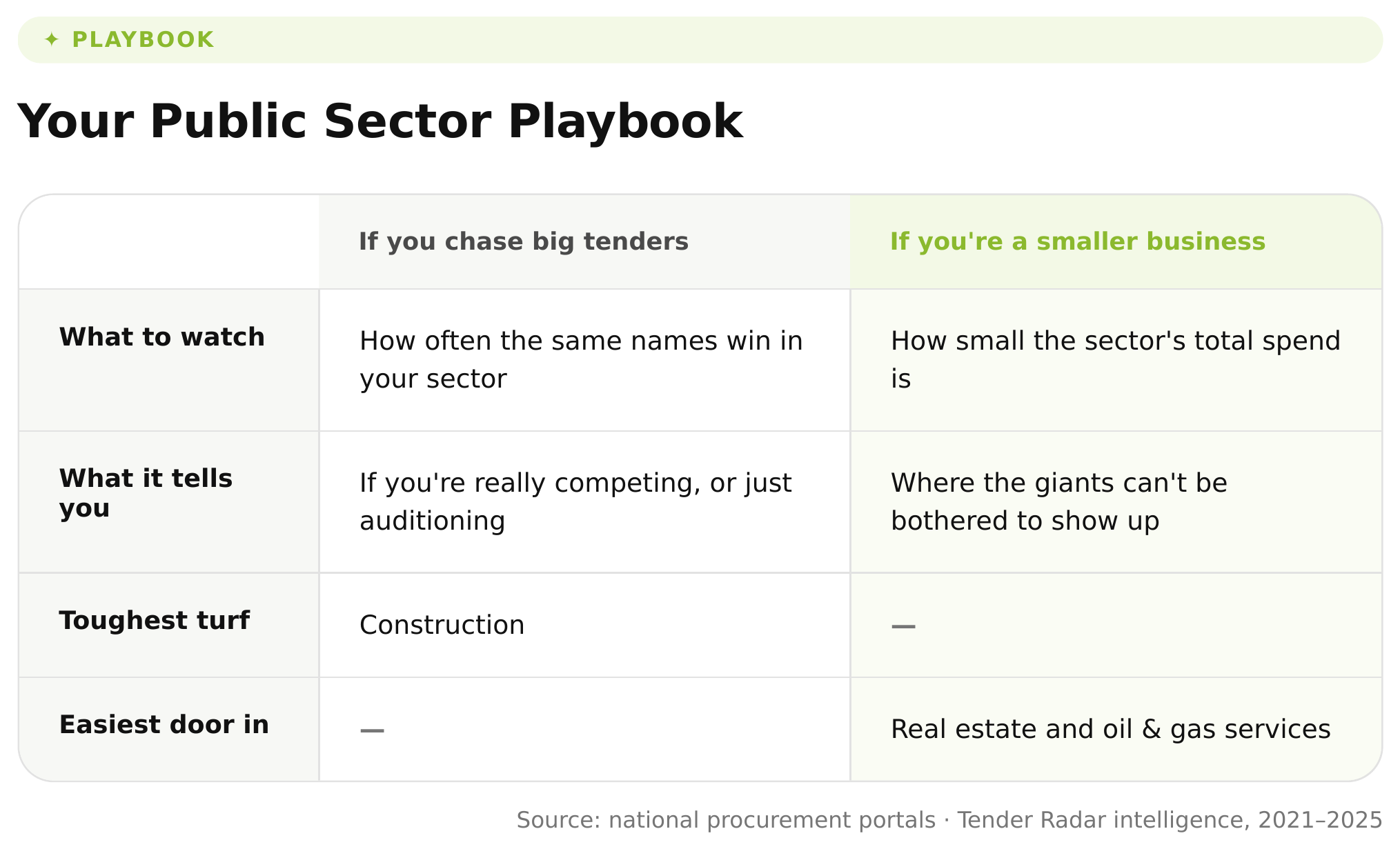
Straight talk for the big-tender crowd: if you keep losing to the same three names in the same sector, it's not bad luck. It's the market telling you exactly where the game is rigged by trust, not rules. To beat them, you need to bring something the incumbent can't, or take your fight somewhere thinner.
And as for small business owners who assume public tenders are only "for the big guys"?
Wrong diagnosis. It's not about size. It's about who the buyer already knows. That's not a wall — it's a door. And it's easier to open than people think; you just have to find the sectors left unguarded.
Sources: national procurement portals (complete dataset), Tender Radar intelligence, 2021–2025.