
Someone in Brussels let a draft escape in early July 2026, and within days, procurement lawyers across Europe were passing it around like a leaked script. The document in question is the Commission's attempt to rewrite the EU's public procurement rules, merging three existing directives into a single regulation that would apply directly in every member state, with no national law required to make it real.
Every outlet that picked up the story ran with the same angle: the fight over "Made in Europe" rules and how much preference EU buyers can give to EU suppliers. It's a real fight, and it isn't over. But they missed the part of this leak that changes how you fill out your next tender document. Two things do that: how your bid gets scored, and what happens if your company has ever tripped an exclusion ground. So that's what we’re breaking down today.
First, the obvious caveat
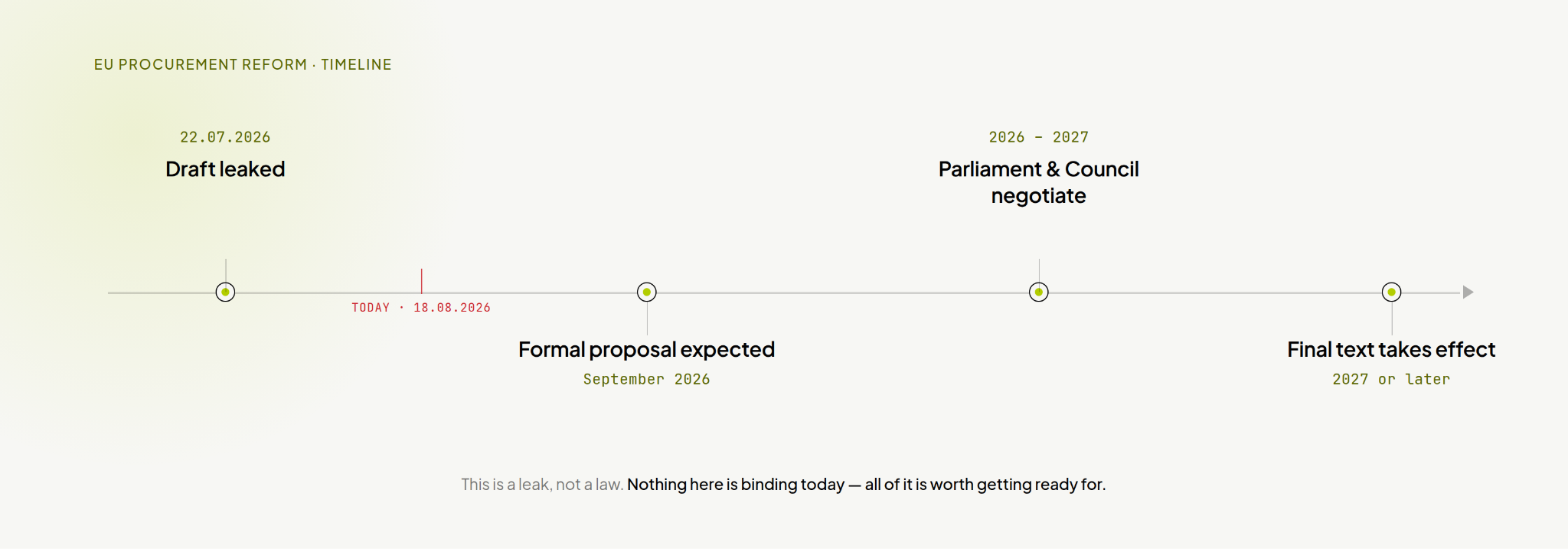
This is a leak, not a law. The Commission was originally due to publish its formal proposal back in the second quarter of 2026. That deadline slipped, and the trade press now expects it to be released in September. Even once it lands, the European Parliament and the Council still have to negotiate a final text together. Legal analysts who've studied similar reforms think that could take until 2027 or later. Nothing here is binding today, but all of it is worth getting ready for.
The scoring change
Right now, EU rules leave it largely up to individual buyers to decide how quality is weighed against price. Many tenders — especially in construction and standard IT purchases — still get decided by whoever quotes the lowest number.
The leaked regulation would take that choice away. Quality would have to count for at least 30 per cent of the score on every contract, rising to 50 per cent for labour-intensive work. This replaces the old "most economically advantageous tender" language with something closer to "best quality for the money." There does appear to be an escape hatch: a buyer could still award purely on price, but only if they say so publicly in the contract notice before bids come in.
That last part is the detail worth remembering. If your pricing strategy has always been "be the cheapest credible option," it doesn't stop working, but it stops being enough on its own for a growing share of tenders. And because the justification has to be public, you'll actually be able to see a price-only contest coming instead of discovering it after the fact.
No more fixing your way back in
Here's the change that should worry more bidders. Under today's rules, a company that trips certain exclusion grounds — a past conviction, a serious contract breach, professional misconduct — can usually clean up its act and argue its way back into eligibility. That's called “self-cleaning”, and it's a genuine second chance.
The leaked draft removes that second chance for the most serious, mandatory exclusion grounds. If your company has one of those on record anywhere in the EU, there's no stated path back into competition. That's worth a conversation with a lawyer well before this becomes binding, not after you lose a tender over something that happened years ago and was never resolved.
The good news nobody's covering
Buried underneath all the noise about European preference is a set of changes that should genuinely help smaller and newer bidders, the exact audience most likely to assume none of this is for them.
Two separate legal analyses of the leak describe a loosening of the financial and experience bars buyers can set. Turnover requirements would come down significantly from where they sit today, and buyers would lose the ability to demand prior public sector experience as a condition of entering a tender. Add a proposed EU-wide digital eligibility system built on a "once only" principle — where you submit your credentials once, then reuse them everywhere — and you give first-time bidders a fair opportunity to compete on quality from the start. If you've never bid because you assumed you'd be filtered out before anyone read your proposal, this is the part of the leak that's actually about you.
What's still genuinely unclear
Analysts agree the draft introduces three new procurement procedures: an open negotiated route as the default, a simplified process for routine repeat purchases, and an innovation challenge model for buying things that don't exist yet. Beyond that, plenty is still moving. The exact wording on exclusion, the final shape of the turnover rules, and how the European preference provisions will read once politics gets involved are all open questions. Anyone telling you the final text is settled is guessing.
What to actually do before September
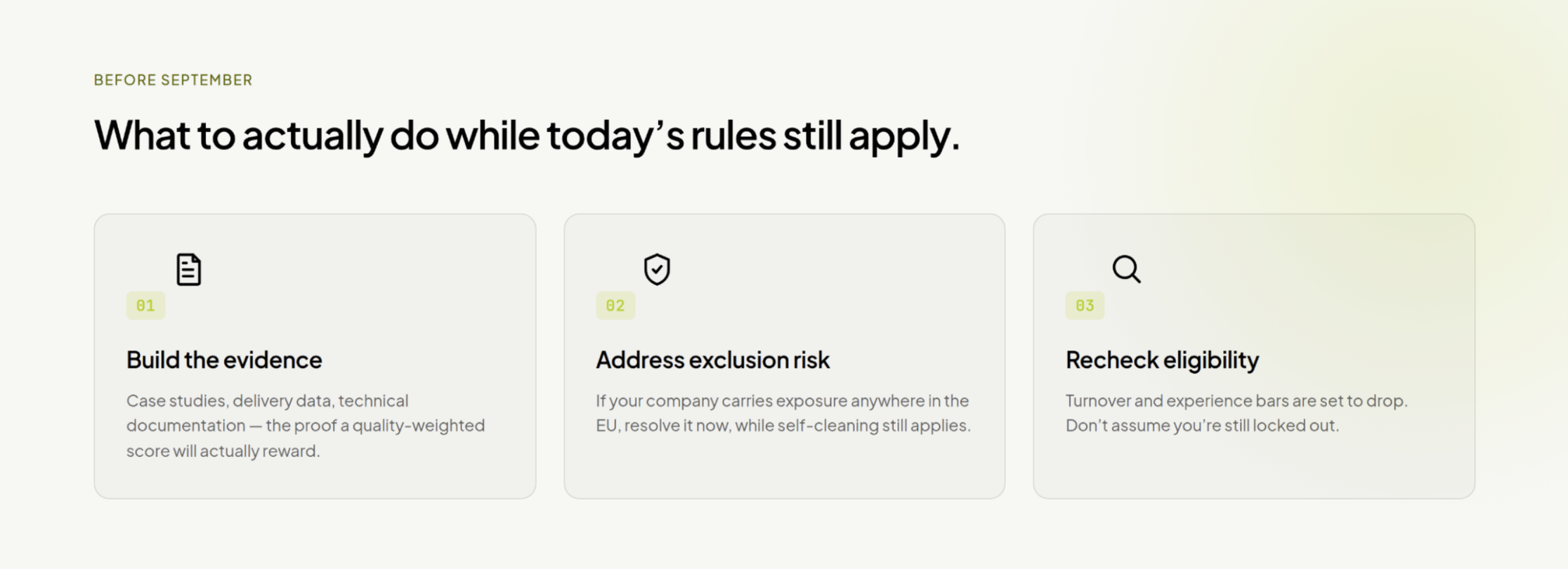
Use the time you have. If your bids have relied on being the cheapest option, start building the kind of evidence, case studies, delivery data and technical documentation that a quality weighted score will actually reward. If your company carries any exclusion risk anywhere in the EU, get ahead of it now, while today's more forgiving rules still apply.
And if you've been sitting out tenders because you assumed the bar was too high, it might be worth checking again in September, once the real text lands.