
Picture the tender you almost didn't bid on because you assumed some multinational from three countries over would sweep in and outbid you. Now picture the actual odds of that happening.
Between 2016 and 2019, only about 7 percent of EU contracting authorities ever received a single bid from outside their own country. Not 7 percent of contracts. Only 7 percent of buyers across the entire EU ever saw a foreign offer.
That number comes from trade economist Lucian Cernat, in a February 2025 policy brief for the European Centre for International Political Economy. His analysis is built on more than a decade of official EU tender data, from 2011 to 2023. This is probably the single most useful statistic for anyone who's ever talked themselves out of bidding because "that's for the big guys." Statistically, the big guys are barely in the room.
Who actually wins when a foreigner wins
When a foreign bidder shows up and wins, it's a smaller, more predictable club than you'd think. In 2015, firms from the UK, Switzerland and the US took more than 80 percent of every contract awarded to a bidder from outside the EU. By 2023, that trio still led the pack, but their combined share had dropped to just over 60 percent, with Canada, Turkey, Israel, Japan and Serbia picking up the rest. The closest thing this market has to " big guys" is a shrinking, concentrated handful of countries, not a wall of multinationals.
What Brexit accidentally proved
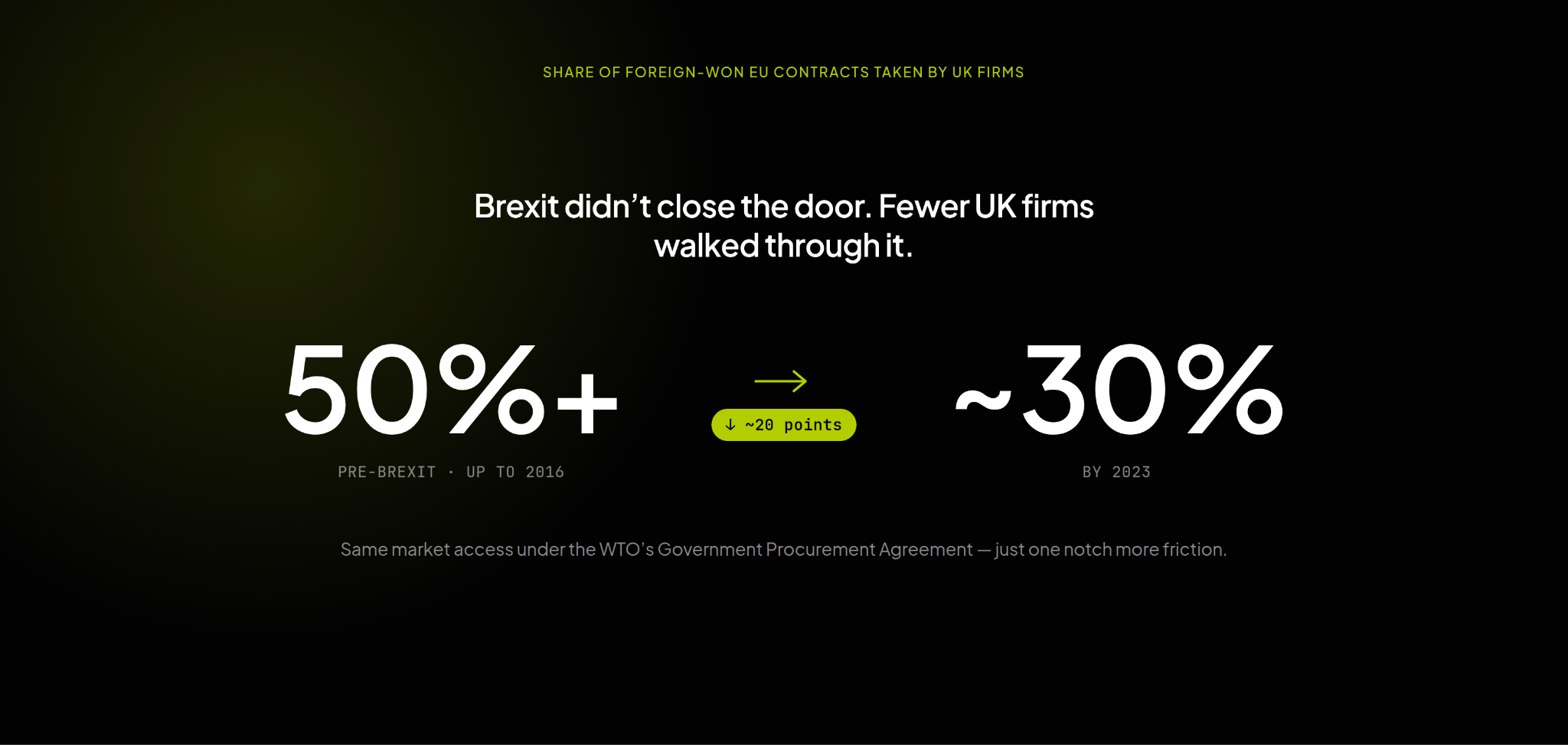
The most telling number in Cernat's brief has nothing to do with rules being tightened. Before Brexit, UK firms won roughly half of the contracts that went to a foreign bidder in the EU. By 2023, that number had fallen, from over 50 percent to around 30 percent of the foreign winner pool.
UK firms didn't lose that ground because a new law shut them out. The UK still has reciprocal access to most EU tenders through its membership in the WTO's Government Procurement Agreement. What changed is that bidding abroad got slightly more complicated, and a meaningful share of firms simply stopped trying. If uncertainty alone can knock twenty points off a sophisticated market's participation rate almost overnight, the "tenders are for the big guys" story was never really about size. It's about who feels like they have a right to be there.
A caveat worth considering
The 7 percent figure is precise, but it isn't the whole picture. The database only tracks bidders applying directly from outside a country. It misses foreign companies that compete through a local subsidiary already registered there, and it misses foreign suppliers working through a domestic company that subcontracts the actual delivery abroad. Cernat's own estimate, which includes all of that, puts total foreign linked participation at close to 50 billion euros in 2017, around 14 percent of the EU's GPA-covered procurement that year.
So the honest version of this story isn't "multinationals never show up." It's narrower than that. Companies almost never bid across a border for the first time, even though nothing is stopping them. Meanwhile, a multinational that already has an office in every market it cares about was never going to show up in this baseline data anyway.
That means you can put down the fear of the cold outsider swooping in, as that fear is practically unfounded. Whether an already embedded local giant is your real competition is a separate question, and this data doesn't answer it either way.
Why buyers should be worried too
If you turn the statistic around, it stops sounding reassuring. If 93 percent of contracting authorities never see a foreign offer, most EU tenders are being decided among a small circle of domestic firms who already know each other and the buyer.
Cernat's conclusion is blunt about why: low participation isn't about legal barriers or bias, it's about firms not bothering to try. That's good news if you’ve been scared off by imaginary competition. It's bad news if you're the public buyer who just received fewer, thinner bids than expected, and it's bad news for the taxpayers footing the bill for that weaker competition.
What to actually do with this
If you've skipped applying for certain tenders assuming bigger, foreign competitors would crush you, the data says that's unlikely. Ninety-three percent of the time, nobody from outside the country shows up at all. Your real competition is almost always local, and usually smaller than you think.
It cuts both ways. If low participation really is a failure to try rather than a wall too high to climb, that's an invitation for a builder in Stuttgart or a software team in Lisbon to look over the border.
Tender Radar tracks tenders across several national portals alongside the EU's own database for exactly this reason. The opportunity most suppliers miss isn't hiding in the portal they already check every morning.