
EU PUBLIC PROCUREMENT
The No-Jargon Guide to EU Public Procurement for Small Businesses
Tender Radar · 7 min read · Small Business Guide
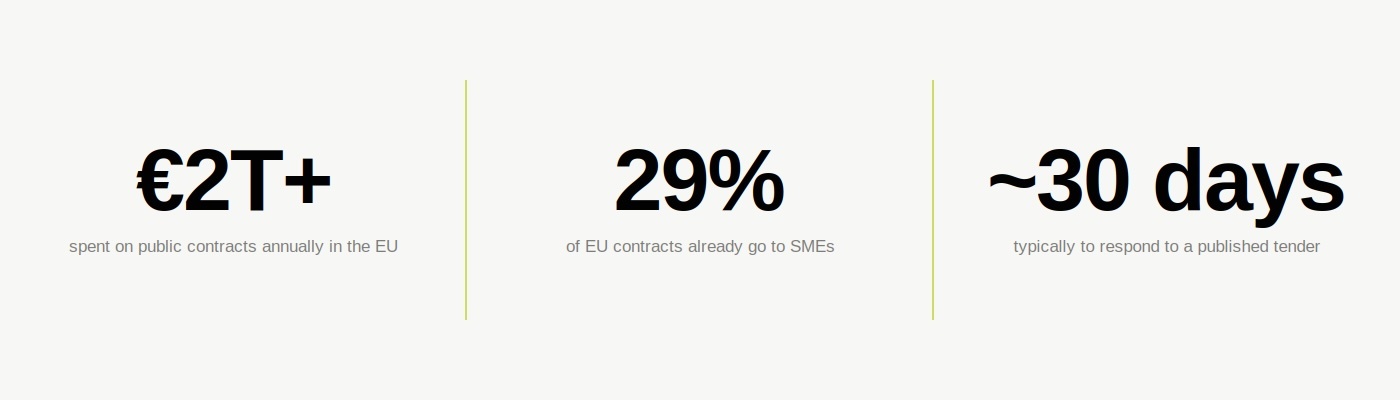
EU public contracts are worth over €2 trillion a year, yet most small businesses never even try to compete. The process sounds intimidating, but once you strip out the jargon, it follows a straightforward path. Here's exactly how it works.
The procurement journey at a glance
Find — Spot the right tender on TED
Read — Understand the Call for Tender
Prepare — Gather your documents
Submit — Send your bid before the deadline
Evaluation — Buyer reviews all bids
Win & Deliver — Sign contract, get paid
Typical timeline: 2–6 months from publication to award
Why public procurement exists (and why it's open to you)
When a government body such as a city council, a national agency or an EU institution needs to contract services above a certain value, it's legally required to advertise the opportunity openly and fairly. That obligation is your opening.
These rules exist to prevent corruption and ensure taxpayer money is well spent. For small businesses, these same rules guarantee equal access. A local printing company can bid for the same contract as a multinational, provided they meet the stated requirements. The playing field isn't tilted, it's defined.
The rules that make procurement feel bureaucratic are the same rules that give small businesses a fair shot at every contract.
Step 1 — Find the right contract
Find: Spot the right tender on TED [TED Portal]
All EU public contracts above certain thresholds must be published on TED: Tenders Electronic Daily (ted.europa.eu). Think of it as the official job board for contracts. You can search by keyword, country, sector or contract value. New opportunities are posted every working day.
Below EU thresholds, each country has its own national or regional platforms. Tools like Tender Radar aggregate these sources so you don't have to monitor dozens of portals manually.
💡 PLAIN ENGLISH TIP
A CPV (Common Procurement Vocabulary) code is a standardised category code that describes what the contract is for, like a product barcode for public buying. Search by CPV to find contracts in your sector without wading through unrelated listings.
Step 2 — Read the documents properly
Read: Understand the Call for Tender [Call for Tender]
Every tender comes with a procurement document (sometimes called a Call for Tender or Invitation to Tender). This tells you exactly what the buyer wants, who can apply, what they'll score you on, and the deadline. Read the exclusion criteria and selection criteria first, as they tell you if you're eligible before you invest time writing a bid.
Exclusion criteria are disqualifying factors, such as prior convictions, insolvency or tax irregularities. Selection criteria check if you have the technical and financial capacity. Award criteria describe how the winning bid is chosen. Together, these three sections answer one vital question: "Is this contract worth pursuing?"
Step 3 — Gather your documents
Prepare: Complete the ESPD — your eligibility passport [ESPD form]
Most EU tenders use the ESPD (European Single Procurement Document) — a standardised self-declaration that replaces the pile of certificates previously requested upfront. You fill it out once, confirm you meet the requirements, and submit the actual certificates only if you win. Almost all EU countries provide one or more ESPD service.
Beyond the ESPD, you'll typically need your company’s registration details, two years of financial statements, relevant case studies and references, and sometimes valid insurance certificates. Keep these in a "bid-ready folder" as you will reuse the same documents for almost every tender.
💡 PLAIN ENGLISH TIP
The ESPD is EU bureaucracy working in your favour. Instead of sending a box of original documents to every buyer, you're declaring, "I qualify." You only have to prove it if you win, which dramatically reduces the paperwork per bid.
Step 4 — Write and submit your bid
Submit: Send your bid via the buyer's e-procurement portal [e-Procurement]
Most EU bodies now use electronic submission platforms. Your bid is typically divided intotwo parts: a technical offer (how you'll do the work) and a financial offer (what you'll charge). These are often submitted in separate, sealed files so the price doesn't influence the technical score.
Deadlines are absolute. A bid received even one minute late is automatically disqualified — with no exceptions. Give yourself a 24-hour buffer before the closing time to handle any last-minute technical issues.
Step 5 — The evaluation period
Evaluation: The buyer scores bids against published criteria [MEAT criteria]
After the deadline, the buyer evaluates bids using the criteria they published in advance. The EU operates on the MEAT principle — Most Economically Advantageous Tender — which means the lowest price doesn't always win. Quality, sustainability, social criteria and technical merit count too. The evaluation process can take anywhere from a few weeks to several months.
Regardless of the outcome, you are entitled to a debrief. If you don't win, always request feedback — buyers are legally obligated to explain why your proposal fell short. This insight is valuable for refining your strategy for your next bid.
Step 6 — Win, sign, and deliver
Win & Deliver: Sign the contract and start delivering [Public contract]
If you win, the buyer enters a mandatory standstill period (usually 10 days) during which unsuccessful bidders can challenge the decision. After that, you officially sign the contract and get to work. Payment terms in public procurement are tightly regulated. Under the EU Late Payment Directive, you are entitled to interest on late payments, giving you more protection than a typical private contract.
The realistic picture for small businesses
Your first bid will always take longer than your fifth. The learning curve is real, but it's a one-time investment — the documents, templates and experience you build will compound over time. Many small businesses find that a single, reliably paid, multi-year contract provides a solid revenue foundation that makes the rest of their business significantly easier to run.
The practical barriers are also shrinking. E-procurement has eliminated the physical paperwork and the ESPD has standardised eligibility checks. Tools now exist to find, filter and monitor relevant tenders automatically — ensuring you only spend time on contracts you have a genuine chance of winning.
Public procurement is designed to be transparent and fair. You don't need a dedicated procurement department to compete — you just need a clear process and the right information.
Those six steps are that process: find the right opportunity, understand what the buyer needs, prepare your documents, submit on time, wait for evaluation and deliver if you win. That's it. The jargon is just simple ideas wearing complicated labels.