
In 2011, the average EU public tender attracted 5.7 bids. By 2021, that figure had dropped to 3.2. Over that decade, the share of contracts awarded after receiving only one bid nearly doubled, jumping from 23.5 percent to 41.8 percent. And in 2021 alone, about 16 percent of all EU procurement went out with no competition at all.
These numbers come from an official report published in December 2023 by the European Court of Auditors. The Court's job was simple: to check how competitive EU public procurement really is. The answer was not good. Despite years of effort from the European Commission and national governments, competition got worse, not better.
How bad is it, really?
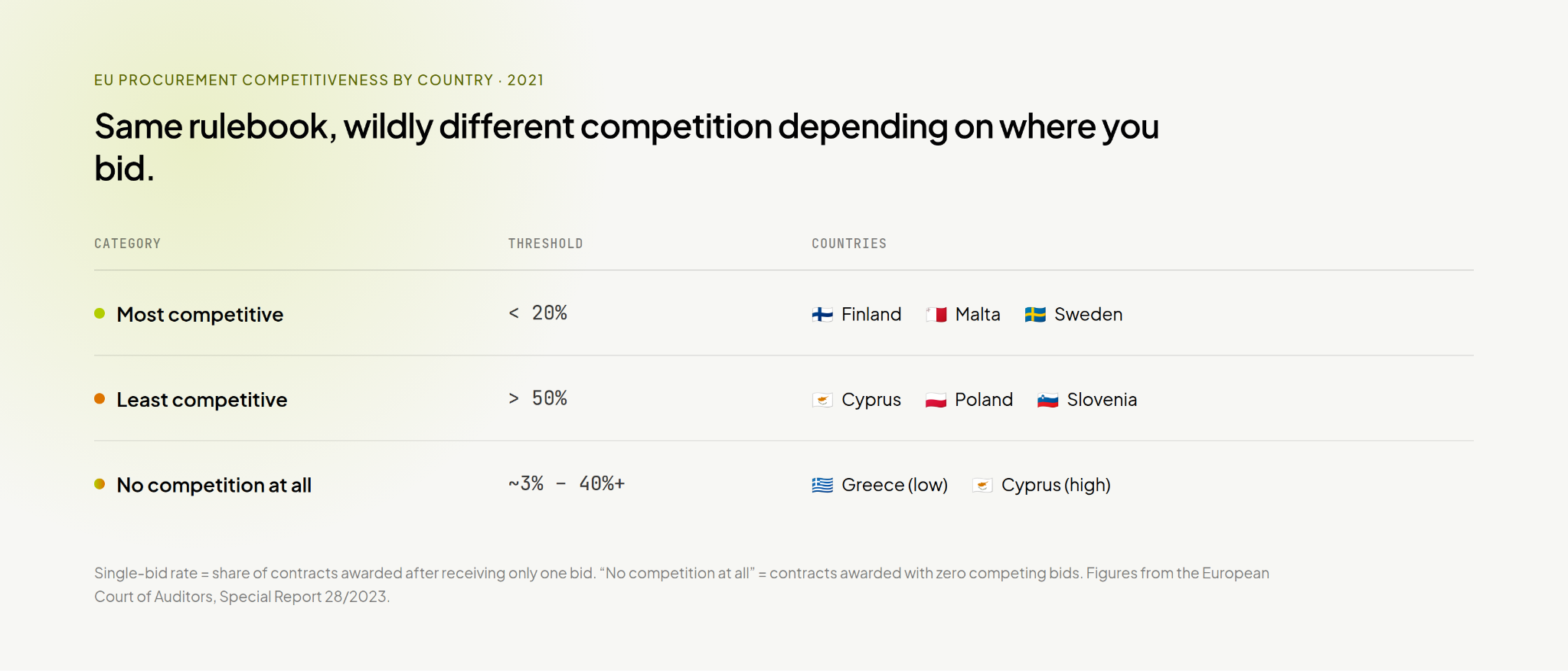
The EU has its own health check for this. The Single Market Scoreboard says a country is doing fine if fewer than 10 percent of its contracts get only one bid. Above 20 percent, it's a warning sign.
By that measure, the EU average in 2021 (41.8 percent) was more than double the warning threshold, and the trend had been getting worse for ten years straight.
The picture varies wildly depending on where you look. In 2021, only three countries, Finland, Malta and Sweden, kept single-bid rates under 20 percent. Cyprus, Poland and Slovenia were all above 50 percent. Contracts given out with no competition at all ranged from about 3 percent in Greece to over 40 percent in Cyprus. Health and transport contracts were the hardest hit, with close to 45 percent single-bid rates.
If you sell into any of these markets, this isn’t just policy talk. It's a rough map of how much competition you're actually facing, or how empty the room really is when you show up.
Why it's happening
When the auditors asked contracting authorities directly why this was happening, four answers came up again and again:
Buyers set requirements that are too narrow and rule out good suppliers before bidding starts.
Some markets simply don't have many suppliers to choose from.
Public bodies lack the staff and time to run good tenders, and procedures now take longer on average, from about two months to over three.
The whole process has become complicated enough to scare off smaller companies.
One thing is missing from that list. The Court never said that public bodies doing the work themselves — instead of tendering it out — is the cause of the problem.
A separate fight is brewing
In May 2026, six industry groups, including BusinessEurope and the European Waste Management Association (FEAD), sent a joint letter to the European Commission. They want to introduce a new rule: before a public body can do work in-house or hand it to another public body without a tender, it must prove no private company can do the job instead.
Their letter points to the Court's report as proof that competition is shrinking. But the Court never said that in-house work is the reason. That's an important distinction. Industry groups are using a real, audited fact to support an argument the audit itself didn't make. That doesn't mean they're wrong — it just means it's their opinion, not the Court's finding.
FEAD backs its case with real numbers from the waste industry.
In Italy, over 90 percent of municipal waste contracts in 2021 were handed out with no competition.
In Latvia, only about a third of the waste collection market is open to competition.
In Germany, state-owned waste companies have steadily gained market share for twenty years.
These are specific numbers from a real sector, not vague complaints. Yet none of what FEAD is asking for shows up in the leaked draft of the new EU procurement law. That draft is about scoring and exclusion rules, not in-house work. Whether this fight changes the final law is still unknown.
What this means for you
If your country or sector is in the red zone on the Single Market Scoreboard, don't read that as the market being rigged. Read it as a market with fewer real competitors than people assume. Fewer bidders per contract means better odds for the ones who do show up. That's a reason to bid, not a reason to stay away.
If you work in a sector where in-house delivery is common, such as waste collection, road maintenance and local transport, keep an eye on this fight. If the industry groups win, more of that work will eventually go out to open tender. What we do know for certain is that EU public procurement became less competitive between 2011 and 2021. Nobody has published newer numbers since, so whether it rebounded or got worse after that remains an open question.