
The EU's proposed Public Procurement Act, published on 9 September, sets a minimum weight for quality in how tenders are scored:
30% on most contracts
50% on labour-intensive contracts — and that 50% must include social criteria, such as working conditions
So on most contracts, price can still count for up to 70%. Being the cheapest still works in most sectors. In labour-intensive ones, it stops working.
What actually changes
The scoring method itself, best price-quality ratio (BPQR), is already in EU law under Article 67 of Directive 2014/24/EU. Buyers just weren't required to use it, and many didn't. In 2017, the Commission reported that 55% of procedures were still decided on price alone.
The Act changes three things:
BPQR becomes the default.
Quality gets a minimum weight: 30%, or 50% for labour-intensive contracts.
Price-only awards are allowed only if the buyer has already secured quality through the specifications or the contract conditions.
Two bids, three scoring models
Take a hypothetical tender with two bidders.
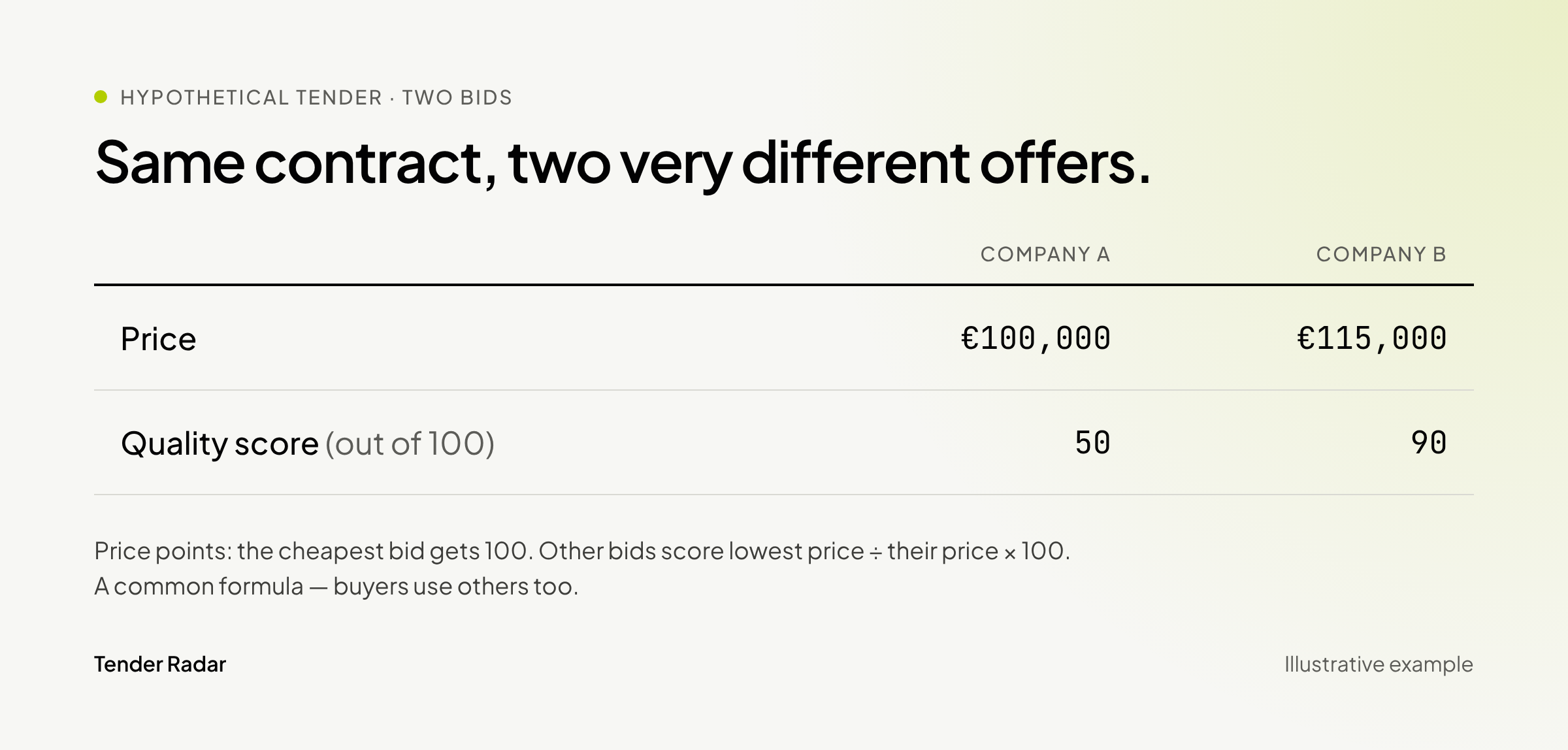
The cheapest bid gets full price points. Other bids get points in proportion to how close they are: lowest price ÷ your price. It's a common formula, though buyers use others too.
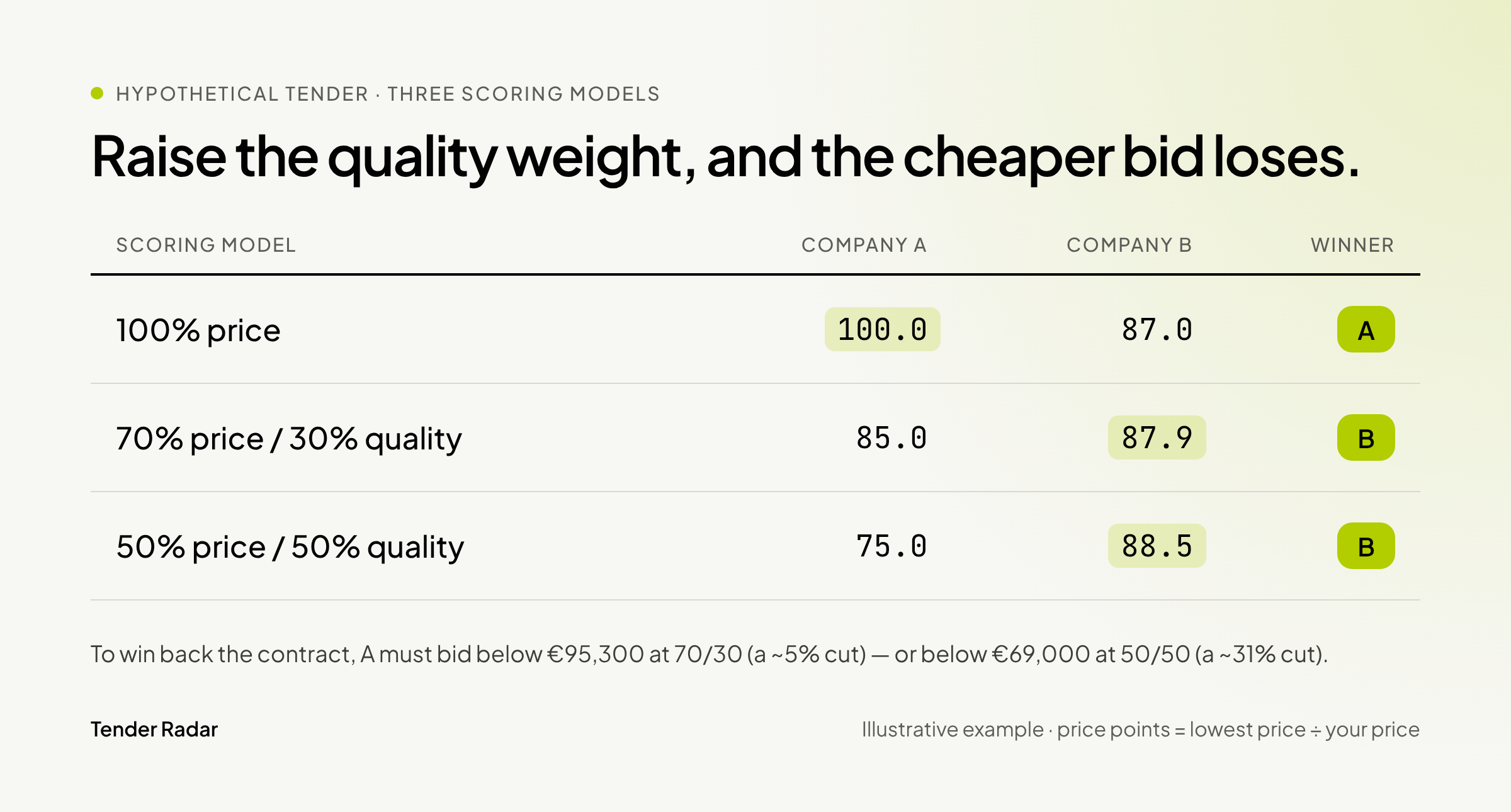
What A has to do to win the contract back:
At 70/30: bid below €95,300 — a cut of about 5%.
At 50/50: bid below €69,000 — a cut of about 31%.
What this means for you
In most sectors, a weak proposal can still win on price. It just costs you more margin.
In typically labour-intensive sectors — cleaning, security, catering, care, and facility management — no realistic discount makes up for a weak quality score.
In both cases, A loses on its quality score of 50, not on its price. Fix the proposal before you cut the price.
What to do now
Ask for feedback on every tender you lose. Buyers have to tell you, on request, what the winning bid did better. Many will also share your scores, which show where you lost points.
Build a proof library. Keep case studies, delivery data, CVs, method statements, and certifications up to date and ready to reuse. Evaluators give points for evidence, not claims.
In labour-intensive sectors, document your working conditions: wages, training, and subcontracting. That's where the social points are likely to come from.
What's still open
This is a proposal. It won't apply before 2029 at the earliest, and Parliament and Council can still change the weights. The Act also doesn't prescribe how buyers must score quality, so a 30% quality weight can produce very different results from one buyer to the next.
Many buyers already use BPQR today, so none of the steps above need to wait.
Sources
European Commission: Proposal for a Regulation on public procurement and concessions, COM(2026) 590 — https://single-market-economy.ec.europa.eu/document/download/59557310-3af0-426d-b6b6-0357b650065f_en?filename=Proposal+for+a+Regulation+-+Public+Procurement+Act.pdf
Directive 2014/24/EU, Article 67 (award criteria) — https://eur-lex.europa.eu/eli/dir/2014/24/oj
European Commission: Making public procurement work in and for Europe, COM(2017) 572 — https://eur-lex.europa.eu/legal-content/EN/TXT/?uri=CELEX:52017DC0572
Arthur Cox: New EU public procurement regime, legislative process begins — https://www.arthurcox.com/knowledge/new-eu-public-procurement-regime-legislative-process-begins/