
Portugal has a startup scene that punches well above its weight, and much of it sells to other companies. Meanwhile, the Portuguese public sector spends billions of euros a year on the kind of things these companies build: software, research, design, consulting, training and equipment. Yet 43% of Iberian digital SMEs have never considered taking part in a tender.
The reason is rarely the quality of their work, but because the system still has a reputation for being slow and complex, built for companies with a dedicated bid department and twenty years of experience.
It isn’t, entirely. From the creative studio in Porto to the climate startup in Lisbon, a small team can win public contracts, and the rules are more open than they look.
We explain how the system actually works, and how to get your foot in the door.
National vs. EU rules: the line that decides where you bid
Every public contract in the EU falls on one side of a line. Above the EU thresholds, the tender must be published EU-wide on TED (Tenders Electronic Daily) and any company in the EU can bid. Below them, each country decides how contracts are awarded.
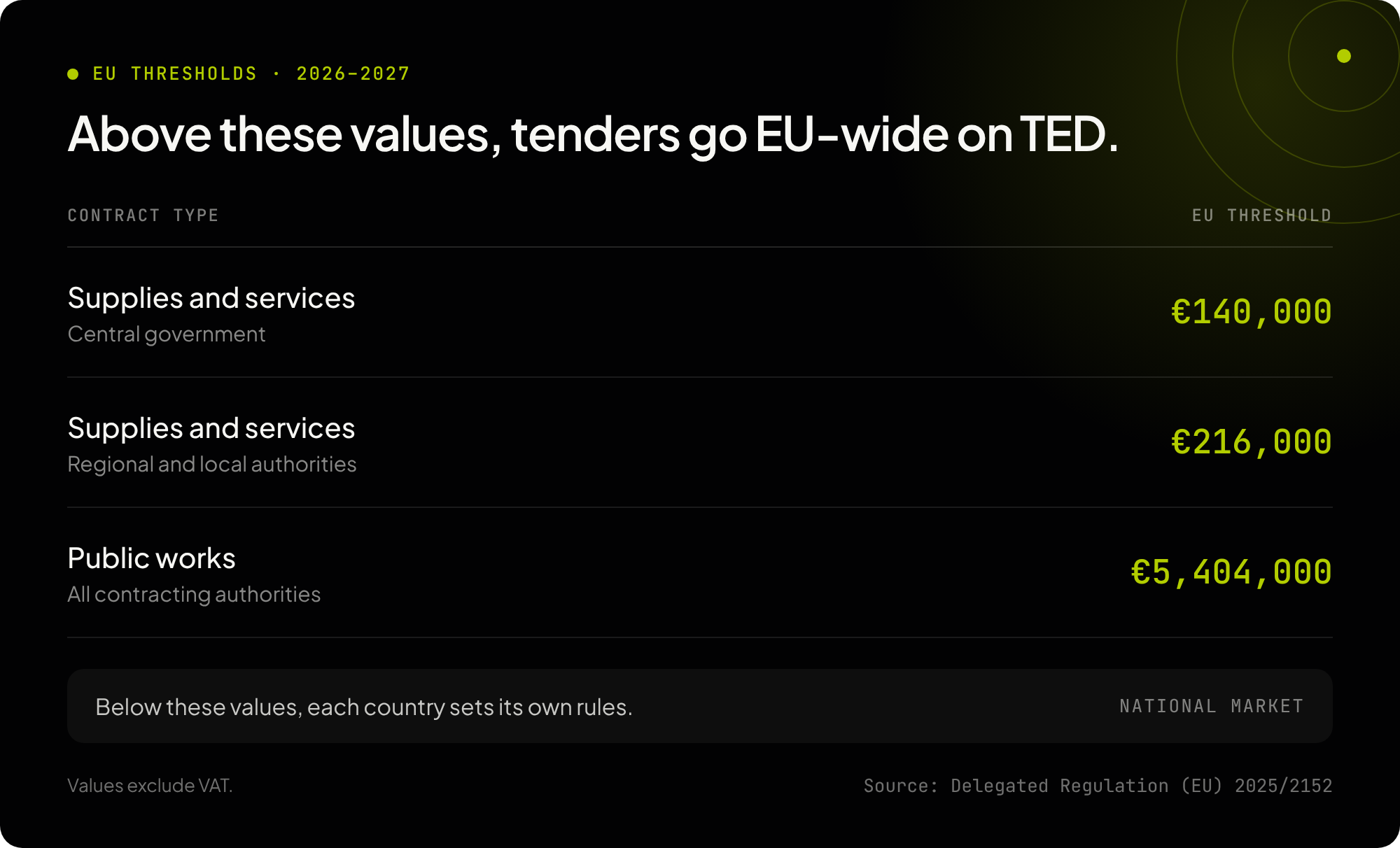
This matters for a startup because most contracts you can realistically win in your first year sit below the EU threshold. Your first bid will probably be a national tender, and in Portugal, the rules have recently changed.
Portugal: what changed on 1 October 2026
Portuguese public procurement is governed by the Código dos Contratos Públicos. For procedures launched since 1 October 2026, Decree-Law 177/2026 has raised value limits significantly.
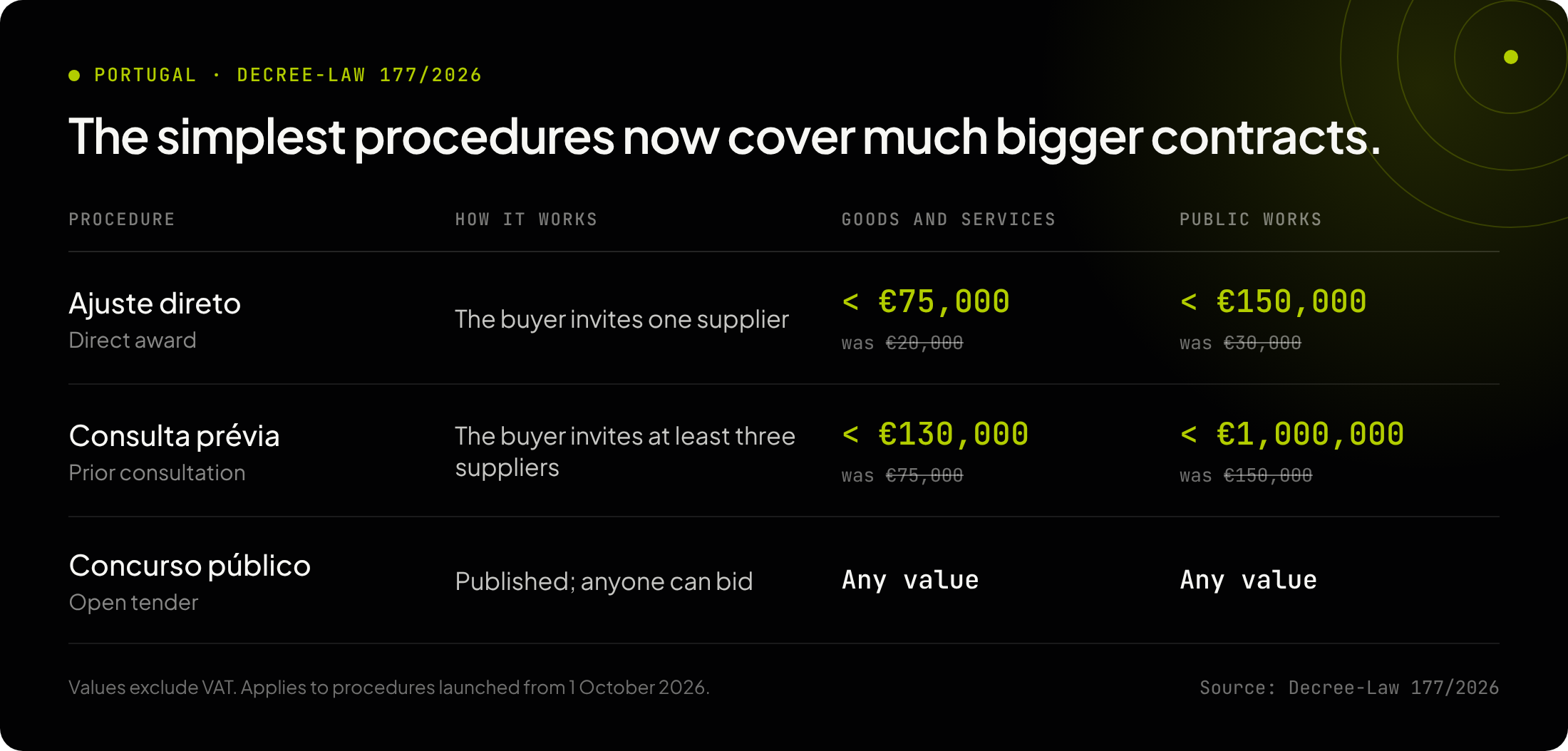
In practice, higher limits mean that a larger share of public spending can now go to suppliers the buyer already knows. A government body offering a €60,000 service no longer has to publish an open tender — they can invite a single supplier directly.
For a startup, that flips the playbook. Watching open tenders is still essential, but being visible to the people who send invitations matters just as much.
Where to find tenders and contracts in Portugal
As in much of Europe, in Portugal there is no single portal for finding and submitting, so it’s easy to miss opportunities.
Here’s where to start searching:
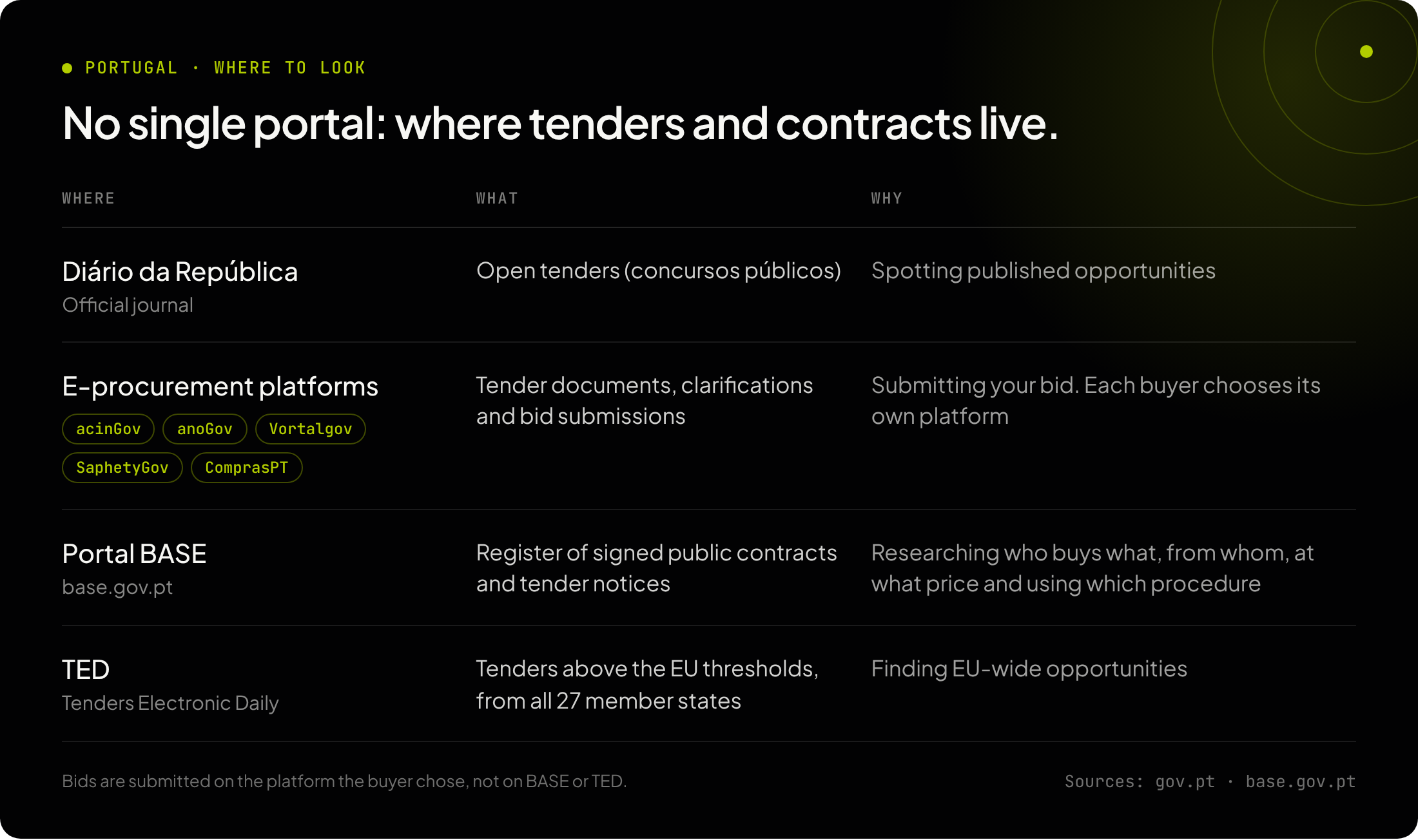
Portal BASE is the most underused. While you can’t submit your bid there, it offers some the best free market research in Portugal. Search for the services you sell and get a list of the buyers who have already paid for them, including the ones awarding direct contracts you will never see advertised.
Five rules that give startups a fair shot
Once you start looking on Portal BASE and TED, the next hesitation kicks in: "We're too X, Y or Z to qualify." Often, you aren’t. EU rules give smaller teams more room than most realise:
Turnover caps: Under EU procurement rules, a buyer generally cannot require annual turnover above twice the estimated contract value unless it is formally justified. A €100,000 contract shouldn't demand a €2 million company.
Mandatory lot consideration: Buyers must consider splitting large contracts into smaller lots—or explain why they didn't. A single lot is often a realistic size for a first bid.
Relying on partners: Companies can bid as a consortium and include the financial or technical capacity of partners in the selection criteria. Pairing with an established firm is a common way to build your first references.
Innovation procedures: Innovation partnerships and pre-commercial procurement exist to buy solutions that don't exist yet. These buyers are looking for new approaches, not long histories.
Price isn't everything: Many contracts are scored on a mix of price and quality. A sharper methodology can outweigh a bigger brand.
What does a first contract look like?
Understanding the playing field a little better is one thing; knowing what to actually aim for is another. When founders picture government work, they imagine multi-million-euro agreements. In reality, your first contract is almost always a small, specific piece of work—and there are three common routes in:
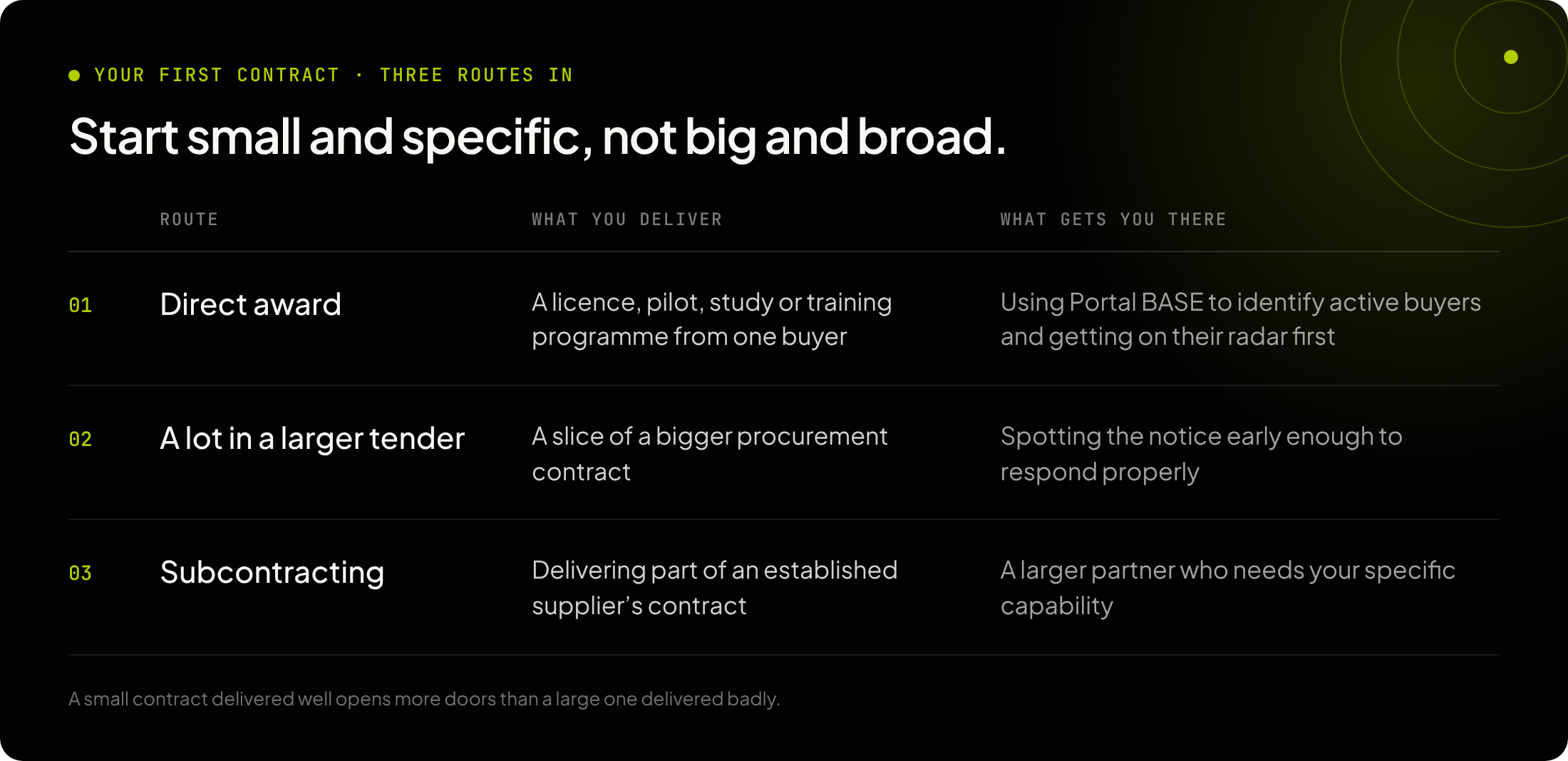
Once you win your first contract, treat delivery as your real pitch. Public contracts have strict deadlines and a public record on Portal BASE. Under Portugal’s new limits, this matters, because a buyer can choose who to invite directly, and they will choose from those they trust. There is a limit, though: across the current year and the previous two, a buyer can only award a total of €75,000 (goods and services) or €150,000 (works) to the same supplier through direct awards and invitations. That means they have to keep adding new names to the list. Price it so you can deliver it properly, scope it realistically and don’t promise features you haven’t built. A small contract delivered well opens more doors than a large one delivered badly.
The EU: one market on paper, many portals in practice
Above the thresholds, every tender in all 27 EU member states is published on TED. In theory, a startup in Lisbon can bid for a contract in Lyon or Ljubljana on equal terms. In practice, very few actually do: only around 5% of EU public contracts are won across borders.
What’s stopping them is rarely the law. It’s the friction. A relevant tender exists on TED, but the documents and bid submission are on the buyer’s national platform, in the buyer’s language. This can be intimidating for a small startup with little or no experience in public procurement.
Three things make cross-border bidding more manageable:
The ESPD (European Single Procurement Document). Called DEUCP in Portugal, this is a standard self-declaration confirming that you meet the exclusion and selection criteria. You fill it in once and adapt it per tender. Supporting certificates are usually only requested from the winning bidder.
CPV codes. Every EU tender is tagged with Common Procurement Vocabulary codes. Knowing five to ten codes that describe your work is the fastest way to filter TED and national portals.
EU institutions. The European Commission and EU agencies run their own tenders through the Funding & Tenders Portal, often for IT, research, communications and evaluation services, and frequently in English.
Where to start: six steps
Get a qualified electronic signature. Bids on Portuguese platforms must be signed with a qualified digital signature. Sort this out first, as it is the most common last-minute blocker.
Register on the main platforms. Create a supplier account on acinGov, anoGov, Vortalgov, SaphetyGov and ComprasPT, so you can read documents and ask questions the day a tender lands, not the day before it closes.
Build your bid folder. Prepare the documents almost every buyer asks for: tax and social security clearance certificates, your company's permanent certificate (certidão permanente) and criminal record extracts for the company and its directors. Keep them current, since most expire after a few months.
Draft your ESPD/DEUCP. Fill in a master version with your company details, capacities and references, then adapt it per tender.
Map your buyers on Portal BASE. Search for contracts matching what you sell. Make a list of the 20 to 30 public bodies that buy it most often, what they pay and which procedure they use.
Set up monitoring. Pick your CPV codes and keywords, then watch the Diário da República, national platforms and TED every week. Or let a tool do it for you.
None of this requires a bid team. It might take a few days to prepare, but it means you’re ready to respond when the right opportunity appears.
Where tenderradar.io fits in
The hardest part isn’t the paperwork. It’s knowing which of the thousands of notices published every week are relevant to you.
That’s why we built Tender Radar. Simply paste your website URL and our AI builds your company profile, scans 90+ procurement portals across Portugal and the EU every day, matches live tenders to your profile and sends you the ones worth your time – with key requirements and deadlines already highlighted.
We take over the searching, which is the part most startups give up on. Join Tender Radar and get matched to the right contracts.
Sources
Commission thresholds for 2026–2027 — Cuatrecasas
Alteração ao Código dos Contratos Públicos (Decree-Law 177/2026) — CMS
Contratos públicos em Portugal — gov.pt
What is the BASE Portal? — base.gov.pt
Special report 28/2023: Public procurement in the EU — European Court of Auditors
Strand Partners (commissioned by AWS), survey of digital SMEs in Iberia, reported by TEK Notícias, 14 January 2026